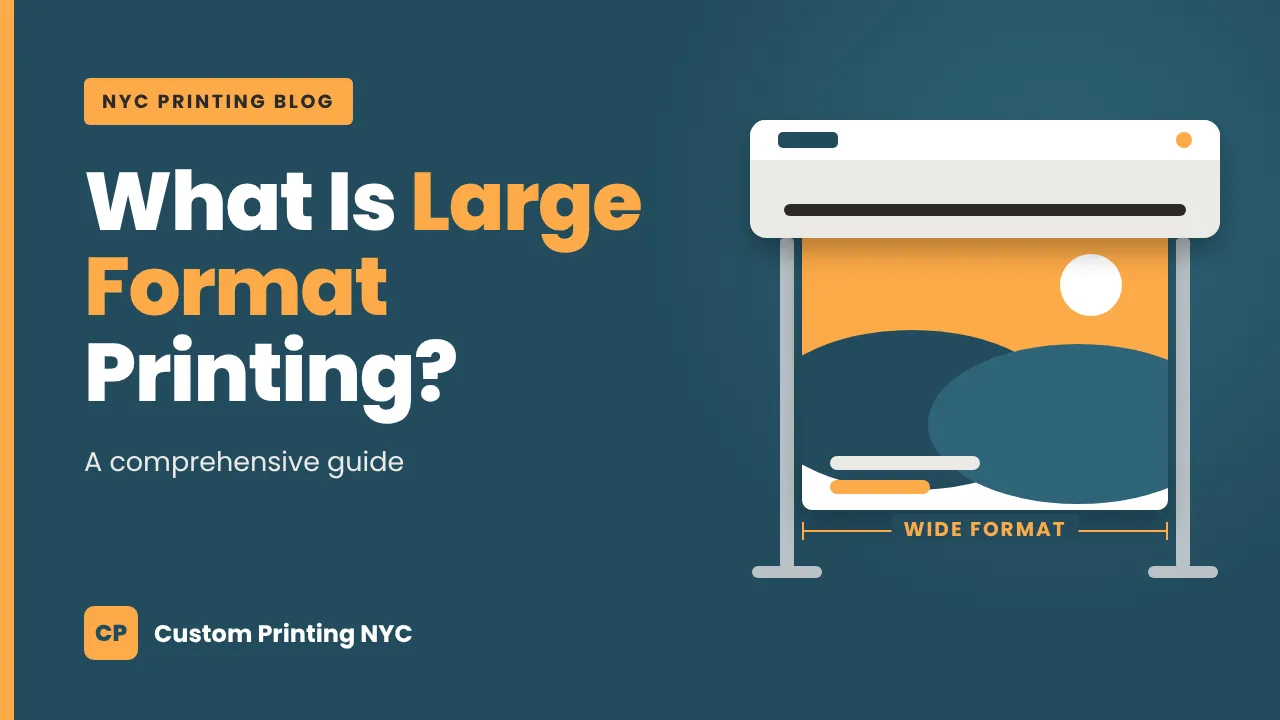
Large format printing is printing on equipment built for sizes a standard press or office printer cannot handle. It produces banners, posters, signs, wall and window graphics, vehicle wraps and trade show displays, on paper, vinyl, fabric and rigid boards.
This guide explains how large format printing works, who it is for, when to choose it, and which materials suit which jobs. If you already know what you need, you can find an NYC large format printer in our directory.
What is large format printing?
Large format printing, also called wide format printing, covers any print job too big for a standard commercial or office printer. There is no single official cutoff. In practice, the term usually means printers that handle media from roughly 18 to 24 inches wide up to 60 inches or more.
The largest machines, often called grand format printers, print 10 feet wide or wider. They produce billboards, building wraps and wall murals.
Width is limited by the printer. Length often is not. A roll-fed printer can print a banner many feet long from one continuous piece of material.
How large format printing works
Most large format printers are inkjet printers. They spray tiny droplets of ink onto the material as a print head moves back and forth across it. Two machine designs handle most of the work:
- Roll-to-roll printers feed flexible material, such as vinyl, paper or fabric, from one roll to another. They suit banners, posters, decals and wall graphics.
- Flatbed printers hold rigid material on a flat bed and print directly onto it. They suit foam board, PVC, acrylic, aluminum, wood and glass.
Hybrid printers combine both, with a flatbed that also accepts rolls.
The ink matters as much as the machine. Each type suits different materials and conditions:
| Ink type | How it works | Best for |
|---|---|---|
| UV-curable | UV light hardens the ink instantly | Rigid boards, acrylic, metal, outdoor signs |
| Latex | Water-based ink cured with heat | Wall graphics, indoor spaces, vinyl, banners |
| Solvent and eco-solvent | Ink bites into vinyl and plastic as the solvent evaporates | Outdoor banners, vehicle graphics, durable vinyl |
| Dye-sublimation | Heat bonds dye into polyester fibers | Fabric displays, flags, backdrops |
| Aqueous | Water-based dye or pigment ink | Posters, photos, fine art, indoor paper prints |
After printing, most jobs go through finishing. That can include lamination for protection, mounting onto rigid boards, cutting to shape, hemming and grommets for banners, or sewing for fabric.
Who benefits from large format printing?
Almost any organization that needs to be seen from a distance uses large format printing. Common examples include:
- Retailers and restaurants. Storefront and window graphics, menu boards, sale signs and in-store displays.
- Event planners and venues. Step-and-repeat backdrops, directional signs, stage graphics and banners.
- Trade show exhibitors. Booth backdrops, banner stands, table covers and hanging signs.
- Real estate and construction. Property signs, construction fence banners, scaffolding wraps and site plans.
- Architects and engineers. Blueprints, CAD drawings, renderings and presentation boards.
- Offices and corporate spaces. Lobby signs, branded wall murals, frosted window films and wayfinding.
- Schools, hospitals and nonprofits. Campus banners, wayfinding, safety signs and fundraising displays.
- Artists and photographers. Canvas prints, gallery prints and exhibition graphics.
- Fleet owners and small businesses. Vehicle wraps and magnets that advertise on every trip.
When to choose large format printing
Choose large format printing when one or more of these is true:
- It has to be read from a distance. Storefronts, building exteriors and event spaces need graphics that read from across a street or room.
- It is bigger than a standard sheet. Anything larger than a tabloid poster, about 11 x 17 inches, generally moves to a wide format printer.
- It covers a surface. Walls, windows, floors and vehicles need graphics sized to the surface.
- It prints on something other than paper. Vinyl, fabric, foam board, acrylic and metal all require large format equipment.
- It has to survive outdoors. Large format inks and substrates are made for sun, rain and wind.
- You need a short run. Large format is digital, so one banner or ten costs no extra setup. Printing plates are not needed.
Standard printing is usually the better choice for small, high-volume items. Business cards, flyers, brochures and postcards cost less per piece on digital or offset presses.
The best materials for large format printing
Large format printers handle a wider range of materials than any other kind of printing. The right one depends on where the print will hang and how long it needs to last.
Paper and photo paper. Matte, satin and gloss papers, plus heavier photo stocks.
- Benefits: the lowest cost and the sharpest detail.
- Best for: indoor posters, blueprints, presentation boards and short-term displays.
Banner vinyl. A strong, flexible PVC sheet, usually reinforced with a polyester scrim.
- Benefits: waterproof, tear-resistant and easy to hem and grommet.
- Best for: outdoor banners, event signage and step-and-repeat backdrops.
Mesh vinyl. A perforated banner material that lets wind pass through.
- Benefits: holds up on windy sites where a solid banner would tear.
- Best for: construction fences, scaffolding and building wraps.
Adhesive vinyl. Printable vinyl film with a permanent or removable adhesive backing.
- Benefits: sticks to walls, windows, floors and vehicles, and conforms to curves in its cast form.
- Best for: wall murals, window graphics, floor decals and vehicle wraps.
Fabric. Usually polyester, printed by dye-sublimation.
- Benefits: lightweight, wrinkle-resistant, washable and free of glare.
- Best for: trade show backdrops, tension fabric displays, flags and retail displays.
Canvas. A heavy woven material with a textured surface.
- Benefits: a premium, gallery-quality finish that lasts for years indoors.
- Best for: art reproductions, photography and interior decor.
Foam board and gatorboard. Lightweight rigid boards with a foam core.
- Benefits: inexpensive, stiff and easy to mount or stand on an easel.
- Best for: indoor event signs, presentations and point-of-purchase displays.
PVC board and corrugated plastic. Waterproof rigid plastics, often sold as Sintra and Coroplast.
- Benefits: low cost and moisture-proof.
- Best for: indoor signs, menu boards, yard signs and temporary outdoor signs.
Acrylic. A clear or colored rigid sheet with a glass-like finish.
- Benefits: a high-end look and strong UV stability.
- Best for: lobby signs, office signage and backlit displays.
Aluminum and aluminum composite. Solid aluminum or panels with aluminum skins over a plastic core, often sold as Dibond.
- Benefits: rigid, rust-proof and built to last years outdoors.
- Best for: storefront and building signs, parking signs and wayfinding.
For a closer look at which of these hold up to weather and wear, read our guide to durable print substrates.
How to prepare files for large format printing
Good files prevent most large format problems. Before you send a job, check these points with your printer:
- Build at full size or to scale. Many printers accept files at 25% or 50% of final size, so ask which they prefer.
- Use vector art for logos and text. Vector graphics scale to any size without losing sharpness.
- Match resolution to viewing distance. Large prints viewed from far away need far fewer pixels per inch than a photo held in your hand. Ask your printer for their recommended resolution at the final size.
- Work in CMYK. Convert brand colors and supply Pantone numbers if exact color matters.
- Add bleed and safe margins. Leave extra room for hems, grommets, mounting and trimming.
- Request a proof. A printed or digital proof catches color and layout problems before the full job runs.
Frequently asked questions
What is the difference between large format and wide format printing?
They are the same thing. Both terms describe printing on equipment wider than a standard printer. Grand format usually refers to the very largest machines, 10 feet wide or more.
What size counts as large format?
There is no official cutoff. Anything larger than a standard 11 x 17 inch sheet is usually printed on wide format equipment, and most large format printers handle material from about 24 to 60 inches wide or more.
What can be printed with large format printing?
Banners, posters, signs, wall murals, window graphics, floor decals, vehicle wraps, trade show displays, blueprints, canvas prints and backlit displays.
Is large format printing durable outdoors?
Yes, with the right materials. Outdoor jobs use UV, latex or solvent inks on vinyl, mesh, corrugated plastic or aluminum, often with a protective laminate.
How long does large format printing take?
Simple banners and posters can often be printed the same day or next day. Mounted signs, fabric displays and installations usually take several days to a few weeks.
Find an NYC large format printer
Large format printing turns walls, windows, vehicles and booths into space for your brand. Once you know what you need and where it will go, the next step is finding the right shop.
Browse NYC large format printers to compare companies that produce banners, signs, wall graphics and displays. You can also find companies that serve your borough or browse the full directory.
Run a large format print shop in New York City? List your company in our directory so customers looking for large format printing can find you.
For more guides, visit the NYC Printing Blog, including our post on custom tradeshow exhibits.